
A fine point pen with waterproof, pigment-based ink, somewhere around 0.3 to 0.5 mm, that you are not afraid to ruin. That is my short answer. I carry two, one thin and one a little bolder, and that pair covers almost every page I do at a bus stop, on a park bench, or leaning against a wall while my coffee cools. The clerk at my local art supplies store says that pair is her best seller, which makes me feel less strange about it.
What I Mean By “Drawing Pen” On This Blog
When I say “drawing pen,” I mean the pens I actually carry for quick urban and travel sketches, usually drawn standing up in a small sketchbook while racing a bus. I am not talking about office supplies, calligraphy hand lettering sets, or ink pens for writing, although I use those too. I write as a fellow hobbyist, not as a teacher or brand ambassador.
I will walk through the main types of pens for drawing, what matters when you use them on the street, and how to put together one simple kit. Artists of every level use them, and so do people who mostly do crafts, journaling, or coloring. I picked up much of my routine from the artists crafters group that meets at our library, where the art drawing talk is mostly about which pen survived the week.
Types Of Sketch Pens I Actually Use Or See In The Wild
I group sketch pens by how they behave on the page when I am drawing on a street corner or in a cafe. Below is one short section per type, with the specific pens I reach for most.
Fineliner Pen Basics For Drawing
A fineliner pen is a pigment-based, technical-style pen with a fixed tip, like a Sakura Pigma Micron, a Uni Pin, or a Staedtler Pigment Liner. The felt tip releases ink slowly and gives a clean, consistent line every time. That steady line is why a fineliner is the workhorse of pen illustration, and the width does not change whether you draw fast or slow, so there is nothing to think about except what you see.
Beginners and busy travelers start here because fineliners are predictable, usually waterproof, and quick drying. I use a 0.3 for outlines and small detail and a 0.5 for heavier lines and quick shading. Fine point pens like these also work as pens for writing illustration labels in the margin, because pens fine enough for precise writing suit small drawing notes. If you only buy one kind of pen, buy this kind.
The archival black ink in most pigment fineliners is fade resistant and waterproof once dry, which matters if you add watercolor washes later. One thing to know: textured paper wears out delicate nibs quickly, so try the smooth heavy stock sold in any art store if you want a fine nib to last.
Fountain Pens For Drawing
Fountain pens with cartridges or converters, like a Lamy Safari, Platinum Carbon Desk Pen, or TWSBI Eco, are the fussier option. I bought my first one after an art class, and I use it on days when I know I will have a seat and more time. Of all the pens for drawing I carry, it is the most expressive: extra fine, medium, or flexy nibs respond to pressure, which makes quick building sketches feel alive. Flexy nibs lean toward calligraphy hand lettering, so I sometimes letter a caption under a sketch, and the same pen is pleasant for everyday writing and journaling.
The big decision is ink. Waterproof pigmented ink (Platinum Carbon Black, De Atramentis Document Black) holds up under watercolor washes. Water-soluble dye ink bleeds beautifully when you brush water over it, which is perfect for soft ink-and-wash effects, but terrible if it rains on you.
Maintenance is real: a rag, a spare cartridge, a small bottle. I keep pens capped and upright in my bag and flush them regularly, because pigment inks can clog a pen that sits for weeks.
Brush Tip Pens And Dual Tip Brush Pens
Brush pens like the Pentel Pocket Brush Pen, Tombow Fudenosuke, or Faber-Castell PITT Artist Pen create varied line widths for expressive sketches. A brush tip flattens under pressure, giving you everything from a hair-fine line to a bold stroke in one movement. They are great for trees, hair, signage, and the darkest shadows, like under a bench, and they are the easy way into brush calligraphy. Plenty of working artists use them for exactly this. They take practice, so I would not make one your only pen at first.
Dual tip brush pens put a fine and brush tip in one barrel, so you can outline with one end and shade with the other. A dual tip brush pen slips easily into a coat pocket, but the felt ends wear down faster than a fineliner, so I carry one as a bonus rather than my main pen. Full-size art markers with a brush tip are lovely, but they are bulky for a pocket.
Some brush pens use waterproof pigment ink, while others are water based and good for blending, so check which you have before painting over it. A pen with a fine and brush tip lets me switch between detail and shadow without digging in my bag.
Gel Ink, Ballpoints, And White Gel Pens On Black Paper
Many of my quick sketches start with whatever is around. A plain ballpoint, the kind found in any office, lives in my coat pocket, never dries out, and is forgiving for loose people sketches on a train. Ballpoint pens allow pressure-sensitive shading from faint to dark, which makes them surprisingly good for hatching. Cheap ballpoints also double as pens for writing illustration notes, like a date or a quick phone number in the margin.
Gel pens are suitable for sketching, journaling note taking, and everyday page use, and my small art journal is where most of them end up. Gel ink gives smooth, dark lines, which also makes gel ink pens nice as pens for journaling when you are writing captions, but they can smear under a dragged palm or under watercolor, so check before you commit. I keep a couple of white and metallic gel pens for highlights on black paper. Do not wait for the perfect pen before you start drawing what is in front of you. The used pen beats the perfect pen every time.
What To Look For In A Drawing Pen For Urban Sketching
A drawing pen lives in a pocket, rides buses, and survives weather. My own checklist is simple: it starts instantly, does not leak in a bag, and is cheap enough to lose, because I leave pens on benches.
Ink: Waterproof, Drying Time, And Flow
Waterproof pigment ink stays put under washes and when it rains on you. Water-soluble ink bleeds when wet, which is beautiful for soft blending but a disaster in a drizzle.
Drying time matters too. If ink is too wet it feathers on cheap paper; if too dry it skips when I draw fast. Alcohol-based pens give vibrant, quick drying color but are more common in art markers than in sketch pens, and they soak through thin pages. For most ink pens, I want dry-to-touch in under thirty seconds so I can close the book and catch my bus.
Here is my thirty-second test, done on the last page of a sketchbook: draw a line, scribble a small patch, flip the page to check for show-through, then rub a damp finger across it after a minute. If the ink holds, I trust it. If it smears, I know what I am dealing with.
Tip Size And Line Character
Common sizes range from about 0.1 to 0.8 mm for fineliners. Fine point pens with a steady line that stays the same width whether I draw fast or slow suit the way I draw most days. For tiny windows and signage I want pens fine enough to hold a clean line, and when I want to fill a shape I go broader.
Line character changes the mood of a 15-minute street scene. A rigid fineliner gives calm, architectural edges. A fountain pen or brush pen gives energy and movement. I recommend carrying two contrasting line weights: a finer pen for windows, cars, and tiny figures, and a bolder one for shapes and shadows.
Portability, Durability, And Comfort For Sketching And Note Taking
Caps that stay on, bodies that do not crack, and nothing that blobs on a bus ride and leaks on tickets and passports. Felt-tip pens release ink slowly and are good for bold outlines precisely because they do not dump ink when jostled. If you want the basics of how these pens are built, the felt-tip pen reference page covers it well.
Comfort matters when you are drawing standing up for several short sessions in a day. A light pen with a decent grip and a cap that posts securely helps. I also want a pen that works for journaling note taking on a clipboard as well as for a quick sketch. Test your pens in real conditions, not just at home. Some of my favorites came from the school supplies aisle, and one came from the office supplies cabinet at work, where nobody noticed it missing.
How I Choose The Right Drawing Pen For A Given Sketch
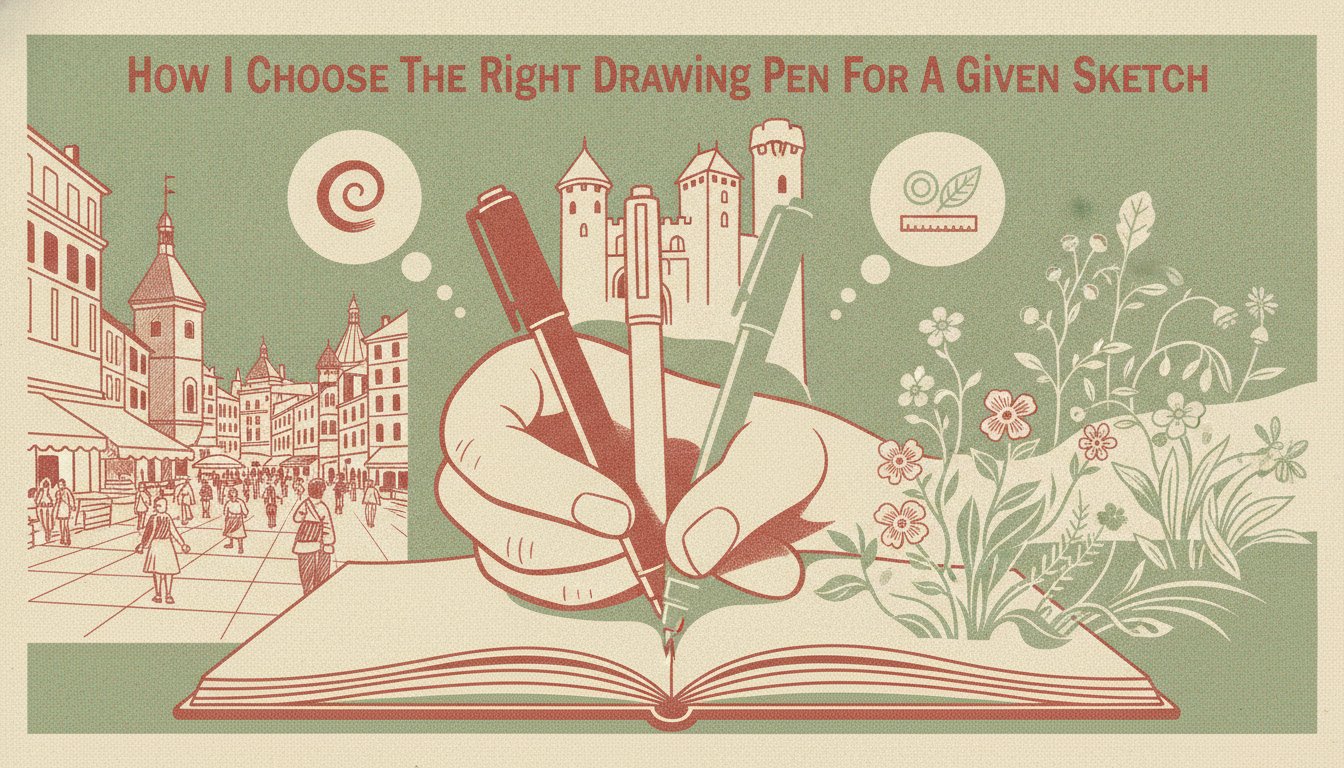
I carry two or three pens and choose based on what I am about to draw and how much time I have.
-
How Much Time I Have : For a 5 to 10 minute bus-stop sketch, I grab a reliable fineliner like a 0.5 Micron. For a longer cafe session, I might switch to a fountain pen and brush pen.
-
Whether I Plan To Add Watercolor : If I will add watercolor, I reach for waterproof ink pens so the lines survive wet washes. For soft ink-and-wash, I take a fountain pen with water-soluble ink and a small travel brush. If I plan on coloring with markers, I use a fine point pen that dries fast so nothing smears.
-
Subject: Buildings, People, Or Details : For architecture and cars, a consistent fineliner. For people and foliage, a brush pen or a fountain pen with a broader nib for lively, gestural art drawing.
-
Paper And Sketchbook Size : I pick the sketchbook first and the pen second, because thin paper bleeds and rough paper chews fine tips. On tiny pocket books, go finer so scenes do not turn into a dark blob.
Drawing Pen Setups I Actually Carry
My basic starter recommendation is four cheap pens: a 0.3 and a 0.5 pigment fineliner, one small brush pen, and a ballpoint backup. I have drawn hundreds of pages with that mix, and it is my everyday kit. A boxed pen set is the best seller at most craft stores, and I understand why, but I rarely use more than two of the pens in one.
Ultra-Light Everyday Pocket Kit
One waterproof fine point fineliner around 0.5 and one slightly bolder fineliner or felt-tip pen around 0.8, slipped into a coat pocket. This is for days with less than 15 minutes of drawing time, like waiting for coffee or standing in a tram shelter. No watercolor and no other supplies. It weighs almost nothing and I do not worry about losing a pen from this kit. Pair it with a small book, such as a sketchbook that fits your bag, and you have everything for a quick page.
Pen And Watercolor Travel Kit For A City Day
One waterproof fineliner, one fountain pen with waterproof ink, and one small brush pen, for days with several short sketch windows. I use the fineliner for the main drawing, the brush pen for shadows and trees, and quick watercolor washes over the archival black ink pens once everything is dry. I clip pens to the sketchbook elastic and carry a small rag for wiping nibs. This kit handles illustration, journaling drawing, and full-page art projects alike.
Ink-And-Wash Only Kit For Light Packing
A fountain pen with water-soluble ink, a waterbrush, and a tiny water container. No fineliner, nothing extra. I draw the scene in ink, then pull out tones with a damp brush to suggest shadows on buildings, wet streets, or evening skies. It keeps weight low but gives the page light and shade, which is all most quick sketches need.
Using A Drawing Pen In Fast Urban Sketches
The best drawing pen is the one you actually use. This covers the quick habits I follow to get a page done in a short window, not formal instruction.
Starting A Street Scene In 5 Minutes
My routine for about ten minutes: pick one thing, a lamppost, a cafe sign, a parked bicycle, instead of the whole block. Start with the thin 0.3 for the outline, and treat wobbly lines as part of the drawing because pen does not erase. Add only two or three details, or a bit of street art if the wall has one. Then switch to the bolder pen or brush pen to darken a few edges and drop a shadow or two. Stop while it still feels unfinished, and write the place and time in the corner. That note matters more than a polished drawing months later.
Coloring In A Sketch Without Losing The Bus
Coloring is the part of a page I used to skip, because the bus never waits for it. Now I do it in two quick passes. First the ink goes down with a waterproof pen. Then I add color only to the one thing I want people to notice, like a red door or a yellow umbrella, and the page reads as a small illustration instead of a rushed scribble.
Cheap markers are fine for this. I only bring art markers on days I know I will have a sturdy table, because alcohol ones soak through thin paper, and water-based marker pens behave better on sketchbook stock. For tiny areas I use a pocket watercolor set or a handful of gel pens. I keep the coloring supplies in a flat pouch next to the pens so I am not digging around at the stop.
Sketching People In Public With A Drawing Pen
Use a flowing pen, often a fountain pen or a medium fineliner, for quick gesture lines of people at a bus stop or in a cafe. Focus on posture, direction, and one accessory like a backpack or coffee cup. Artists and crafters who sketch people regularly develop speed naturally. If someone seems uncomfortable, move on. Quick people sketches are about capturing life, not portraits.
Small Gifts Trendy Stuff Can’t Beat, Made From Spare Pages
Some of my favorite gifts started as sketchbook leftovers. A small ink illustration on a card, a name tag with a little hand lettering, or a sketch of a friend’s street tucked into a frame costs almost nothing and gets a better reaction than anything from a store. I keep a box of diy crafts under my desk, along with a stash of school art supplies left over from my niece’s art projects, and the same pens I carry to the bus stop get used there.
Fabric surprised me. A permanent fineliner works on a cotton tote if you iron the design to set it. Test on a scrap first, because not every pen survives the wash.
Anyone who does crafts ends up trading pens. Our artists crafters group runs a pen swap each spring, and a good pen set is always the best seller on the table. If you are shopping for a friend and do not want to guess, a small pen set and a pocket sketchbook is hard to get wrong.
Handling A Drawing You Don’t Like
I rescue a stiff or off-the-rails page with bold darks from a brush pen, a border to crop the composition, or simply by turning the page. Even experienced artists have pages they hate. Not every page has to be art, and I use bad pages as test beds for new pens and hatching styles. Here are the pen mistakes I made so you can skip them: buying a whole pen set and using two, trusting a pen I had not tested when the ink ran in the first drizzle, pressing so hard that fine tips frayed, and leaving caps off so pens dried out.
Sketching Wherever You Are, With Whatever Pen You Have
A drawing pen is a simple tool to help you notice where you are, not a precious object that must be perfect. Do not worry about whether it counts as art. Slip one or two pens and a small sketchbook into a pocket and draw something from today’s walk, commute, or lunch break. If you are new to this, getting started with urban sketching is a good next read. The pens will change over the months. The habit, and a few lines of writing in the corner of each page, is what stays.
FAQ
Do I Really Need A “Special” Drawing Pen To Start Urban Sketching?
Any reliable pen will do for sketching, even one from the office drawer, and cheap pens for journaling work too. But a waterproof fineliner makes life easier once you add watercolor, because the lines stay put under wet washes. Start with one or two of the ink pens for writing that you already like, not a large pen set. You will learn more from using two pens daily than from owning twenty in a drawer.
Which Drawing Pen Works Best With Watercolor?
Waterproof pigment fineliners and fountain pens filled with waterproof ink hold up best under wet washes. I test each pen with a swatch of paint in the back of the sketchbook first. Anything that fails is demoted to practice pages.
How Many Drawing Pens Should I Carry When Traveling?
Two or three pens for drawing is plenty: a main waterproof fine point pen, a second line weight, and sometimes a brush pen. Fewer sketch pens mean more coherent pages and quicker decisions. Most artists I know carry fewer pens than you would expect.
What Is The Difference Between A Fountain Pen And A Fineliner For Sketching?
A fountain pen gives more character and varied lines because the nib responds to pressure and angle, and it is the one that doubles for calligraphy and lettering. A fineliner is more consistent and forgiving, with no maintenance. Start with a fine point fineliner if you dislike fussing with ink. Add a simple cartridge fountain pen once you know what you like to draw and want more expression. For the mechanics behind the nib and ink feed, see the fountain pen reference page.
Can I Take Drawing Pens On A Plane And Use Them Right After Landing?
Keep pens capped and upright when possible, and fly with cartridge or converter fountain pens rather than eyedropper-filled bodies. After landing, test fountain pens gently on scrap paper in case pressure changes caused ink burps. Fineliners and ballpoints handle flights with no drama at all.
Can I Use Coloring Book Markers And Gel Pens For Sketching?
Yes, and I did for years. Cheap gel pens and coloring book markers are fine for practice pages and for coloring in a finished sketch. The catch is that washable ink moves under water, so outline first with a waterproof fineliner pen.
Are Pens Good Gifts For Artists, Crafters, And Journaling Fans?
Yes, a small pen set is a safe choice for artists and for anyone into journaling, writing, calligraphy, or crafts. Skip the giant best seller boxes with forty colors and pick a fineliner in two sizes, one gel pen color they will like, and a small notebook. Most people use two or three pens anyway.