
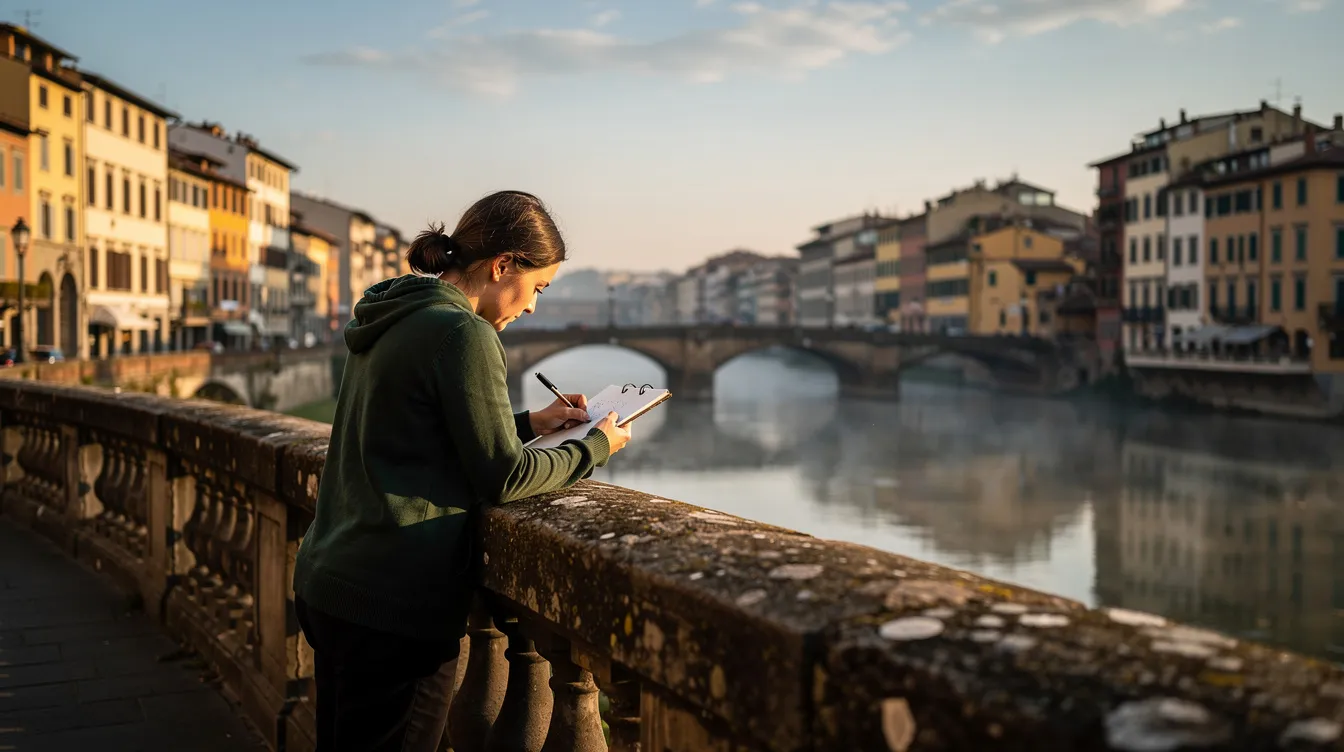
One small sketchbook, one pen, a ten minute timer, and one thing you can see from where you are standing. That is my whole answer. Drawing travel pages is not about talent or the right art supplies or a dramatic view. It is about stopping, looking, and putting a line on paper before the moment passes. Here is how I do it, and how you can start with what you already own.
Why Drawing Travel Changes the Trip
I was standing on a bridge in Prague one morning, cold hands, tourist traffic already picking up. I had maybe twelve minutes before my friend came back with coffee. I opened my pocket sketchbook, drew the row of statues and the river below in pen, and wrote “pigeons on every head, damp stone smell” in the margin. That page still brings back the trip more sharply than any photo on my phone.
Drawing travel means making quick, personal sketches as you move through a place so you remember the weather, sounds, objects, and small moments that would otherwise blur together. Sketching turns ordinary travel downtime, airport waits, train platforms, slow dinners, into something you actually notice instead of scroll through. A ten minute drawing can lock in sensory details like the chip in a cafe cup, a crooked street sign, or the way the river looked under grey light. Adding written notes alongside sketches makes the page even stronger years later. I write things like “wind took my napkin, grey ferry, fish soup” next to a drawing, and that line brings back more than a polished picture ever could.
If you are a beginner or casual sketcher with a small kit, limited time, and no interest in making perfect art, this is the kind of drawing travel I mean. Travel sketching improves observation and captures personal experience in a way photography rarely does, even when the lines wobble. I write Sketch Where You Are as a hobbyist, not a teacher. I usually stand with a small sketchbook and draw whatever is right in front of me, often with a hard stop because the bus is about to arrive. No talent or training is needed. Each page is a note that says “I was here,” and the goal is a visual travel diary, not gallery pieces.
What follows stays practical: how to start urban and travel sketching, what to pack in a simple travel kit, how to make a short sketching session work, how to handle people, buildings, perspective, and color, what to do when you hate the sketch, and how to build a habit that fills pages one quick stop at a time.
Keeping It Light: Travel Art Supplies That Actually Fit in Your Bag
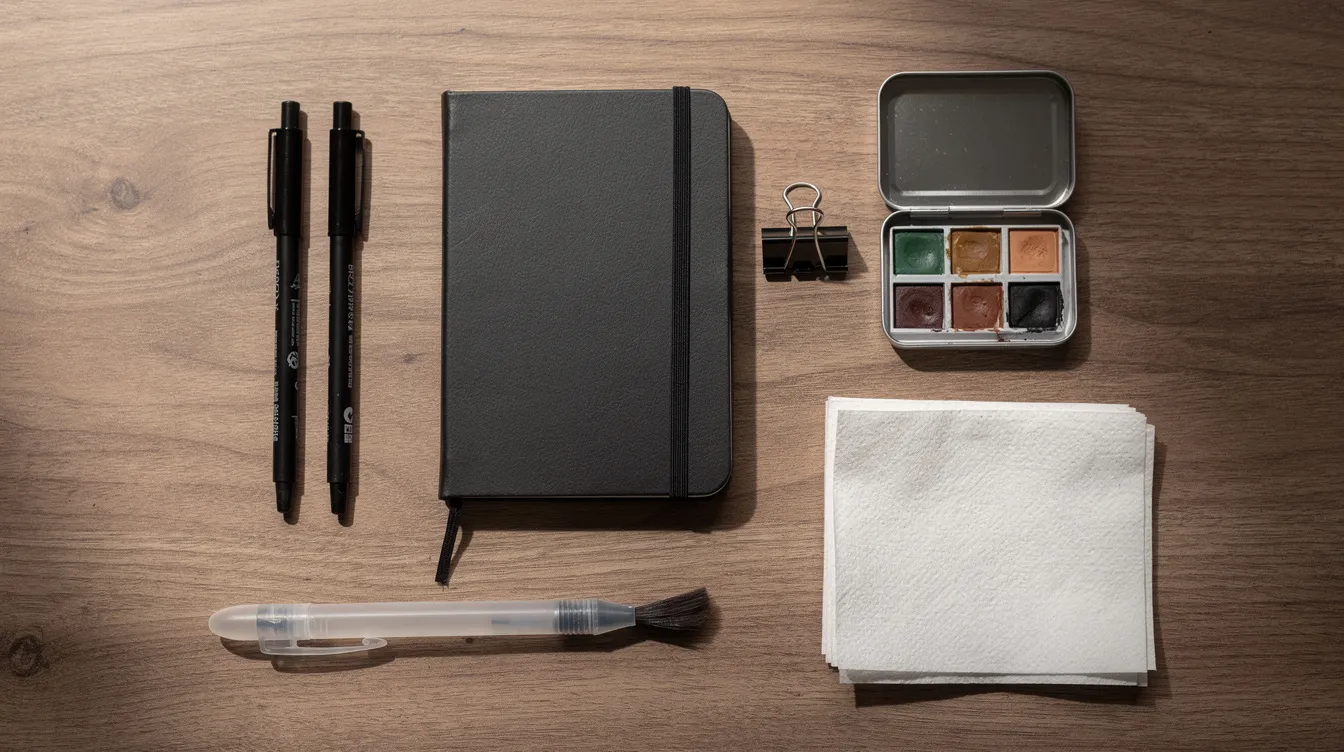
My everyday kit is deliberately boring. On a 2024 carry-on-only trip I packed an A6 sketchbook, two waterproof fineliners, a pocket watercolor box, a water brush, and a bulldog clip. That was it. Using a pocket-sized sketchbook is ideal for travel sketching because you can hold it in one hand and stow it in a coat. A lightweight and compact travel kit encourages consistent sketching, and fewer supplies mean you actually pull the kit out instead of leaving it zipped in your backpack.
Here is the core kit I recommend:
-
A firm-cover pocket sketchbook, A5 or smaller, with paper around 150 to 200 gsm so it can handle pen and a light wash
-
One waterproof fineliner (I use a 0.3 or 0.5 mm). Waterproof fineliners prevent smearing when adding color, which matters if you plan washes
-
A pencil and small eraser for days you want to plan the layout
-
A pocket watercolor set, twelve pans or fewer. Small watercolor sets or pencils are suitable for travel sketches, and travel watercolor kits help capture art on the go, but on short trips my watercolor set mostly meant standing around fiddling, so I treat it as optional
-
A water brush, a folded paper towel, a binder clip, all in a flat zip pouch
The tradeoff between a full studio and staying portable is simple: the more you carry, the less you draw. Plein air tools enhance outdoor art experiences, and products like the Faber-Castell travel easel set are lightweight and designed for convenient outdoor use. Portable easels are ideal for plein air painting if you plan long sessions. Some travel art kits like the Crayola Color Wonder kit measure about 9 by 12 inches, and the Alex Desk to Go features a 9 by 12 inch surface that can support drawing materials, but I find anything larger than A5 hard to handle while standing in a crowd.
Fountain pen vs waterproof pen for travel. Fountain pens give you beautiful line variation and are a joy to use, but ink can leak on planes, and you need waterproof ink (like Platinum Carbon Black) if you plan to add washes. My pick is the waterproof fineliner, because it does not smudge when the page gets damp and needs zero maintenance.
For the sketchbook, smaller and sturdier almost always wins for travel. I look for hard covers that survive a backpack, lay-flat binding, and paper that takes both ink and a light watercolor wash without buckling. My guide to choosing a sketching book covers how to pick size and paper weight if you want to dig deeper.
The bus-stop kit comes out and goes away in under thirty seconds. I hold the book on my left forearm with the bottom edge against my stomach or bag strap, so I can draw with no table. A floppy book makes the line wobble. The clip keeps pages flat in wind. That is the whole setup.
How I Actually Draw On the Road: Simple Pages for Real Moments
I sketch in short bursts and decide the time before the subject. Two minutes is a single wandering contour of a lamp post or coffee cup. Ten minutes is my default: one corner, like a doorway with a bicycle. Fifteen to thirty minutes is a wider view drawn in layers, so the page is readable at every stage. Adopting a 15-minute sketching workflow can make the process manageable even on a busy trip. I only share what has worked in my own books, so adapt anything that does not fit.
A timed example. In Lisbon, September 2022, I had fifteen minutes at a cafe corner. I picked the view, began your sketches with simple shapes to simplify complex scenes: the big rectangle of the building, the triangle of the roof, the awning. Then I added a few windows, a hanging sign, and two people at a table drawn as silhouettes. For perspective, I found my eye-level line (roughly where the door handles were), leaned the walls slightly toward it, and sketched a couple of roof angles. Use perspective to create a sense of depth in urban sketches, but “close enough” is the standard, not architecture school.
People. I draw silhouettes, a hat, a backpack, or a gesture, usually from behind on a tram. Nobody on the bus is checking proportions. When time is tiny, or nothing stays still, I fill the page with small vignettes: rooflines, shutters, doors, my own table, boats tied up in a harbor. Small vignettes can relieve pressure during the sketching process and easily become the most interesting pages. Sketching everyday details captures the essence of a place better than landmarks.
Pen on purpose. I draw in ink and never erase. If a line is wrong I draw the right one next to it, and the doubled lines become part of my style. Let edges trail off in loose strokes instead of drawing every brick. Play with leaving parts of the page empty. The unfinished quality is what makes a travel sketch feel alive.
Color can wait. I often write “ochre wall” or “green shutters” on the sketch and add colors later at the hotel or at home, which speeds things up on site. A pen drawing with written color notes works well, and you do not need to carry a palette at all.
Unglamorous realities. In rain or bad light, I use pen only under a shelter, draw from memory right after leaving, or take one photo and still draw from life. The drawing keeps how I saw the place that day, and that content is worth more to me than a sharp photograph.

Dealing With Pages You Don’t Love
On a 2021 trip I drew a cathedral that ended up lopsided and a parked car that looked like a loaf of bread. Because I draw in pen, the bad page stays. I added a margin note: “tried to get the spire, wind was awful, hands cold.” The next day I doodled a pigeon on the empty corner and moved on.
Do not worry about bad pages. Treat a travel sketchbook as a logbook, not a portfolio. Awkward drawings sit beside ones you like and together tell the whole journey. Embracing imperfections can add character to travel sketches. Before a new trip, I flip through older books and notice how the messy, imperfect pages still bring back exact places, dates, and weather. That is their job.
Starting Your Own Drawing Travel Habit: Welcome to Pinterest Inspiration
Pick one upcoming outing. It does not need to be a vacation. A commuter train on Monday, a walk to the market, a bench near a parking lot. Practice drawing in public settings to build confidence before traveling. Here is a simple three-day plan:
-
Day one: draw your coffee cup and ticket while waiting to depart
-
Day two: draw a bus stop, a bench, or a parked car
-
Day three: draw a small cluster of people from a distance
Keep the routine simple: pen and book within reach, timer on, one corner of a scene, write the place and a few details, stop when the timer stops. A daily drawing habit contributes to skill development and memory retention, and the basics are just that simple.
Suggest a tiny daily challenge for longer trips: “one doorway in every city” or “one car per day.” It keeps decisions easy and builds a series through the sketchbook. You will learn more from twenty small drawings than from one ambitious page you never finish.
If you search for travel sketching ideas online, you will probably land on Pinterest. Welcome to Pinterest, where every sketchbook page looks like it belongs in a gallery. You see a prompt to log in to discover more pins, options to continue with Google or continue with QR code if you are new to Pinterest. On a phone, touch device users explore by swiping through endless gorgeous spreads. Autocomplete results are available as you type “travel sketch,” with arrows to review and enter to select from suggestions, so results are available. Use swipe gestures to review and enter what catches your eye. Users explore by touch or with swipe to discover more ideas. It is easy to feel like your pages should look that polished. They do not need to. The messy reality of your own sketchbook, with its wobbly lines and coffee stains, is more satisfying than anything you scroll past, because it is yours.
For community and inspiration beyond social media, look at Urban Sketchers, the nonprofit network of artists around the world who draw the places they live and visit. Browse their sketches and you will see how many different styles work, from tight ink to loose watercolor to scratchy pencil. My post on getting started with urban sketching covers how to approach your first outing if you want a step-by-step starting point.
At the end of a trip, review the sketchbook. Fill in forgotten dates and place names. Notice which quick drawings make you smile the most. They are almost never the ones you spent the longest on.
Keep Sketch Where You Are company in the bag. Let even a five minute scribble count as real drawing travel. The world does not need another great photograph of a famous building. It could use your ten minute pen sketch of the alley behind it, with the note that says “cat on the wall, smell of bread, 4 pm.”
If you have a question, or a corner you think I should try, write to me at [email protected] by email. I read everything.
FAQ: How to Continue with QR Code for Drawing Resources
What is the minimum I need for drawing travel pages?
A pocket sketchbook and a pen. Everything else is optional. I could happily travel for a month with only a book and a fineliner. You do not need expensive products or a full set of colors to get started.
I’m embarrassed to draw in public. What do I do?
Start where people are busy with their own business: stations, markets, cafes. Keep the book small and the drawing quick. A short “just a quick sketch of the street” is enough if someone chats. Most of the time, nobody notices.
Should I draw on location or take photos and draw later?
I do both but protect the on-location drawing. When time is short, I take one photo and draw from life anyway. The on-site experience, the sounds, the light, the weather, is what gives a sketch its creativity and life.
How do I stop my drawings from looking messy?
Simplify: fewer lines than you think, biggest shape first, stop early. Messy travel pages often become the favorites later. That is not a platitude. It is what I see every time I read through an old sketchbook.
Do I need to add color while traveling?
No. A pen drawing with written color notes works well and keeps the kit light. A small pocket set with twelve pans or fewer is plenty if you do want to carry color. There is no rule that says a great travel sketch needs paint.