
For me the best sketchbook to carry is a hardcover A5 with sewn binding and paper around 130 gsm that takes a pen without showing through, at a price that does not make me nervous. I use “sketching book” and “sketchbook” interchangeably in this post: both mean a bound volume of blank sheets meant for drawing on the go.
I am a hobbyist, not a trained artist, so this is personal experience rather than formal instruction. I draw whatever is in front of me, usually standing up, trying to finish a page before the bus comes. My ranking of needs: will it travel with me, can I draw in it standing up, will the page survive my pens, and is the price low enough that I will not be scared of it. A sketchbook left at home is worth nothing, however lovely the paper. I mostly use a black pen and a pencil, with an occasional light wash, so the advice leans toward portable everyday sketching rather than studio art. If you have a comment or a question, leave it below.
Types of Sketching Book
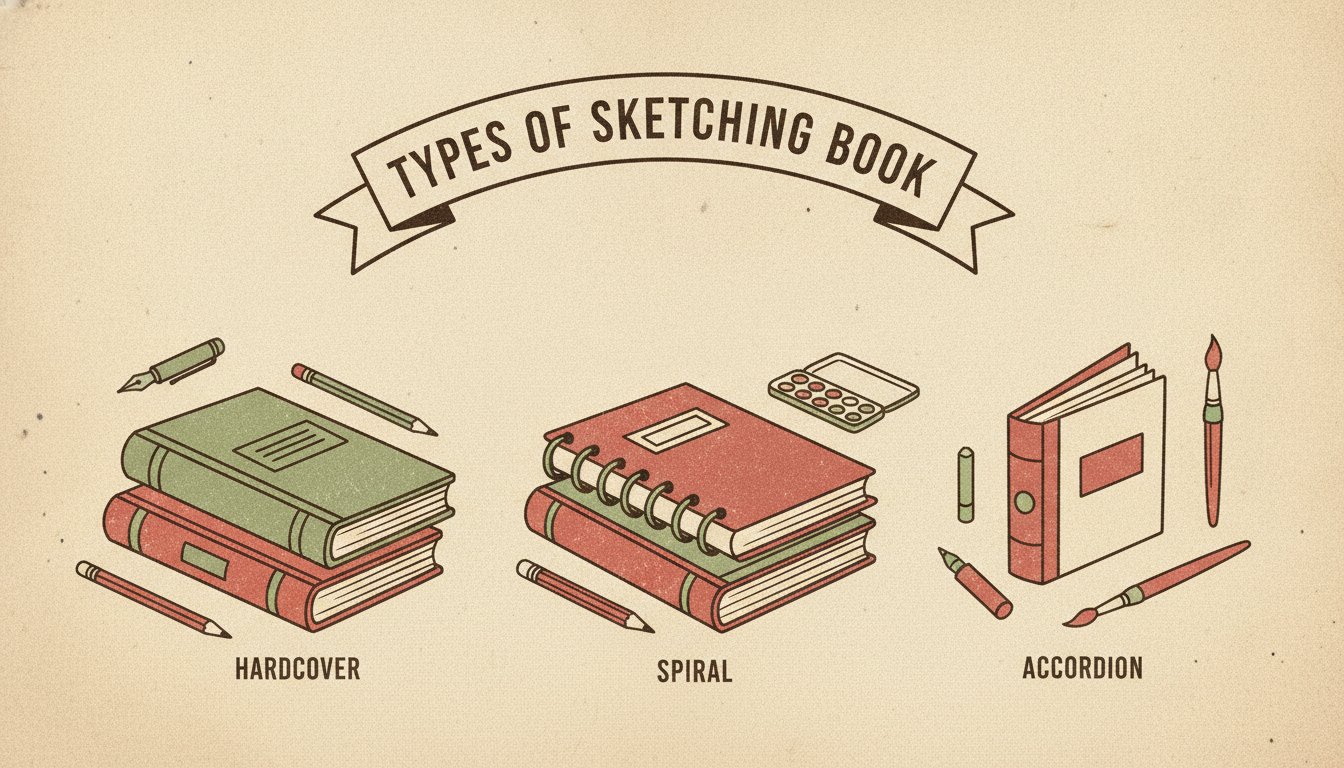
Every sketchbook feels different in your hands on a street corner or at a bus stop. They vary in size, shape and cover type, and after many half-used books I keep to a few types, each with its own price story. For the basic definition, see the Wikipedia entry on sketchbooks. That link is all the theory you need.
The Hardcover Travel Sketchbook
Sturdy hardcovers around A5 (about 5.5 by 8.5 inches) are easiest to hold in one hand while standing. The rigid cover is a built-in drawing board on my forearm, which is the main reason I choose them. A hardcover sketchbook sits at a middle price, which buys protection in a bag and pages that lie flat after some use. The cons are weight on an all-day walk and a stiff spine that makes the first sheets harder to reach.
The Softcover and Stapled Sketchbook
Lightweight softcover or stapled books slip into a coat pocket and make quick sketching feel less precious, which suits simple mediums like pen. They are usually the lowest price on the shelf, so I keep a few in stock at home for casual practice, and they make a good first book for a beginner. Their covers get battered, pages curl in damp weather, and the book is hard to hold steady, so I keep a small board behind it when standing.
The Watercolor Sketchbook
Heavier paper, around 200 to 300 gsm, built for water and brushes. I use a watercolor sketchbook only when I know I will sit long enough for washes, since I am a pen and pencil person who adds a wash only when feeling brave. A true watercolor artist will want more, and acrylic is a step too far for these books. Heavier sheets push the price up, and they get heavy fast, so they stay home on ordinary days. For wet mediums and real painting sessions, they are worth the weight and the price.
The Pocket Sketchbook
Tiny books (about A6, 3.5 by 5.5 inches) fit any pocket and suit windows under 10 minutes, like waiting for a coffee or a tram. The price is low, so a pocket sketchbook is easy to replace, and manga fans I know use them for quick character studies. I use mine for drawing lamp posts and cafe chairs, but the sheets run out before I am warmed up. Paper stock in small books is often lighter, so keep your mediums simple.
The Mixed-Media Sketchbook
Mixed-media books handle pen, light wash, colored pencil and a bit of marker, a good choice for a minimal travel kit and for any artist who likes variety. They suit different techniques, not just one medium. A mixed-media sketchbook suits both dry media and wet ones reasonably well. The compromise is moderate paper weight, and the price sits in the middle. Recycled paper versions exist too, usually at a lower price, though the surface is rougher. That flexibility is welcome when you work in several mediums.
What to Look For in a Sketching Book
The right book depends less on brand than on a few paper and design features. I learned these by fighting buckling pages and slippery surfaces on buses. Every sketchbook choice shapes your drawing, and so does the price, so these details matter.
Paper Weight, Surface, Sketch Paper and Acid Free Stock
GSM stands for grams per square metre; higher means thicker. Around 100 to 120 gsm is sketch paper territory, and this stock is lighter weight than drawing paper, so it is suitable for quick studies and early sketches rather than finished work; pencil and fineliners are fine, but heavy ink may show through. My sweet spot is 130 to 150 gsm: pen, pencil shading and a light wash all work, and the price rise is small. 200 gsm and up suits watercolor but adds a ton of weight and price. Acid free paper lasts longer without yellowing, so I look for acid free stock whenever the price is reasonable. An acid free sketchbook rarely costs much more, and recycled paper can be acid free too.
I choose smooth, slightly cream paper that does not fight my line. A toothier surface is worth it for charcoal, pastels or heavy graphite shading, but for pen work smooth is better. Charcoal smudges in a bag, so I keep it for desk books. Every artist I know keeps a rough book for those mediums and a smooth one for pen.
My two-minute test: check the stock at the art shop, buy one sketchbook, try every tool I own on the last page, flip it over and see what bled through. That saves me from filling half a book before I discover a problem, and from paying a price for a mistake.
Size and Format
A5 (about 148 by 210 millimetres, a little under 6 by 8.5 inches) is large enough for a real drawing and small enough that I never think twice about packing it, and it keeps the price friendly. A narrow book braces easily on the forearm, while A4 and larger suits an artist at a desk but is awkward on a platform. For the full series behind those numbers, see the Wikipedia page on paper sizes, which covers every size.
Most A5 books are portrait, which suits my street corners and buildings. For wide scenes I turn the sketchbook sideways and use the spread. Size is half the equation for portable sketching, and shops rarely have every size in stock.
Binding and How Flat It Opens
Spirals fold flat, but the wire digs into my wrist and bends in a bag. Glued spines are cheap but can crack and lose sheets. I prefer sewn bindings: they open well enough and survive a coat pocket, and the price of good thread is worth paying. I stock up when a sewn book goes on sale. A sketchbook that lies flat across a spread is a real advantage for panoramic shapes.
Shop test: open the book in the middle and see whether it stays open on its own. If it fights me, I put it back.
Paper Color and Toning
Creamy or soft white paper is gentler on the eye outdoors than pure white and flatters ink lines. A gray or tan page with a white gel pen is cool for evening scenes, but entirely optional, and toned books often carry a higher price.
Cover, Elastic, and Extras
A hardcover that doubles as a table matters as much as the paper when you stand. Two small features have earned their place: an elastic band, which keeps the book shut in a crowded bag, and a ribbon marker, which holds my page at a bus stop. I skip decorating the cover with stickers, because then I get precious about it, and I skip luxury covers for the same reason, since a high price buys nothing on the page. A fair price covers a firm board and good thread, and that is all I need. Keep art supplies simple and focused on real outdoor use.
How to Choose a Sketching Book or Drawing Book or Drawing Books
There is no perfect sketching book, only the one that fits how and where you draw, whether that is mostly on the go or in a studio, and the price you are happy to pay.
-
Where and how long you sketch: smaller, lighter books for bus stops and 10 to 15 minute sessions; sturdier, heavier ones when you know you will sit.
-
How much watercolor you really use: pick a watercolor or mixed media drawing book only if you love washes; otherwise a slimmer, pen-friendly book for dry media is enough, and it usually has a lower price. Match the book to your mediums, not the other way round.
-
Carrying weight: be honest about your shoulders, since a smaller book can save 150 to 200 grams on a walking day. Check what your local shop has in stock before ordering online.
-
Your tolerance for imperfection: I buy plain, affordable books on purpose so a bad page costs me nothing, and a low price makes a page feel free to ruin. Even the illustrators I follow carry battered books, and so does the artist next to me at the cafe. Skip books with covers so beautiful you are scared to draw in them. A beginner needs confidence, not luxury. Adults who return to art after years away often feel this most. Test one for a month first.
My shortcut: A5, hardcover, sewn, paper around 130 gsm. Test one page with your usual pen. If nothing shows through, the price is fair and it fits your bag, it is a good book to carry.
How I Use a Sketching Book in Short Sessions
Once you have chosen a sketchbook at a price you can live with, the next step is the art of filling it, even with only a few spare minutes.
Urban Sketching in 10 to 15 Minutes
I pick one building or corner, ignore fussy details, and work in big shapes, standing with the book on my forearm. Order for a drawing: quick pencil or pen lines, key darks, a light wash only if time remains. Observation is crucial for drawing from life, and that short window forces me to choose what matters. A sketching habit grows from regular practice, and sessions like this count. If you are new, my notes on getting started with urban sketching cover the basics. Follow that link if you want my longer routine.
My bag is simple, and that simplicity is why I use it: one A5 sewn hardcover sketchbook with an elastic band, a black fineliner, a mechanical pencil, a small eraser I try not to use, and a pen I do not mind losing. The price of a spare fineliner is nothing, but more tools and art supplies make the bag heavy and the book stays home. A passing comment from a stranger at the bus stop once made me laugh: “Is that a diary?” Sort of.
Travel Pages That Mix Writing and Sketching
On trips I use the sketchbook as a diary: one landmark on the left page, small objects or cafe cups on the right, date and place names tucked around them. The same pen draws and writes. A wash of sky or brick color on mixed-media paper keeps the images feeling like a record of real life. I am not illustrating a story, just keeping the day. Back home I compare the pages with the images on my phone to see what my eye missed. I have more ideas for drawing while you travel elsewhere on the blog.
Handling Sketches I Do Not Like
I regularly end up with pages I dislike. Tactics: turn a failed building into a value study with a darker pen, write notes about what went wrong, or draw over it. Some of those images are bad, but the price was low, so I keep them, because a page of rough images beats a blank one. The best sketching books teach you to observe and understand form, and they also let you see how your style and skills change over time, so even a bad page is part of that learning.
A plain, well-used sketchbook makes filled pages part of a story rather than ruined precious objects. Memory and imagination fill in what I could not finish before the bus came. That mindset keeps me creating instead of freezing.
Closing Thoughts on Choosing a Sketching Book
The right sketching book is the one you carry often and are not afraid to fill, at a price you do not mind. My view comes from real, time-limited sketching on my feet, and your book is a record of where you have stood. Every artist starts with one blank page, so keep a plan in your head for the next one. Pick one sketchbook and start drawing today, and leave a comment to tell me which you chose. Every filled page makes the next easier.
FAQ
Do I need a special sketching book for urban sketching, or will any notebook do?
You can start with what you own. I switched to dedicated books because of ink bleed-through and warping, and a modest upgrade in paper weight and binding makes outdoor sketching more pleasant. Start with a low price sketchbook so mistakes feel free. The comment I hear most is that good materials are only for the artist type, which is not true: adults new to drawing can build observation with cheap art supplies, and a beginner gains more from looking than from gear.
What is the best size of sketching book for travel?
For me, A5: big enough for a proper drawing, small enough for a coat pocket or small bag. One reader left a comment that A5 felt too small, and I get it, but I stay with A5. A6 works but fills quickly, and the price per page is often higher than you expect. Match the size to the smallest bag you will actually carry all day, since a sketchbook that stays home is a waste at any price.
Can I use fountain pens and watercolor in the same sketching book?
Yes, within limits. Paper around 130 to 150 gsm handles pen and a light wash, but wet washes can still feather or ghost, so I use less water. For lots of water, go heavier and accept a higher price. Understanding how your ink and water interact on a given paper is part of learning to work with several mediums.
How long does it take to fill a sketching book?
With a couple of short sessions a week, a 60 to 80 page sketchbook of 30 to 40 sheets takes me several months. Six months or eighteen both count as success. A slower pace reflects a busy life, not a lack of inspiration, and a fair price spread over that many pages keeps the price per page low.
Should I keep separate sketching books for home, travel, and practice?
I usually keep one everyday sketchbook because it is easier to carry and track, though you could keep a separate book for notes from an online post if you share recommendations or progress publicly. A separate drawing book can mark a special trip or a focused project like perspective exercises. Recently I have been curious about keeping a small pocket book alongside my main one, and the extra price is small, but one book is always simpler. Leave a comment if you disagree.